

My Role
UX Designer
Team
Self-directed project
Target Audience
Prospective students
Current dormitory residents
Dormitory administration
Platform
Mobile App (iOS/Android)
Admin Web Panel
Summary
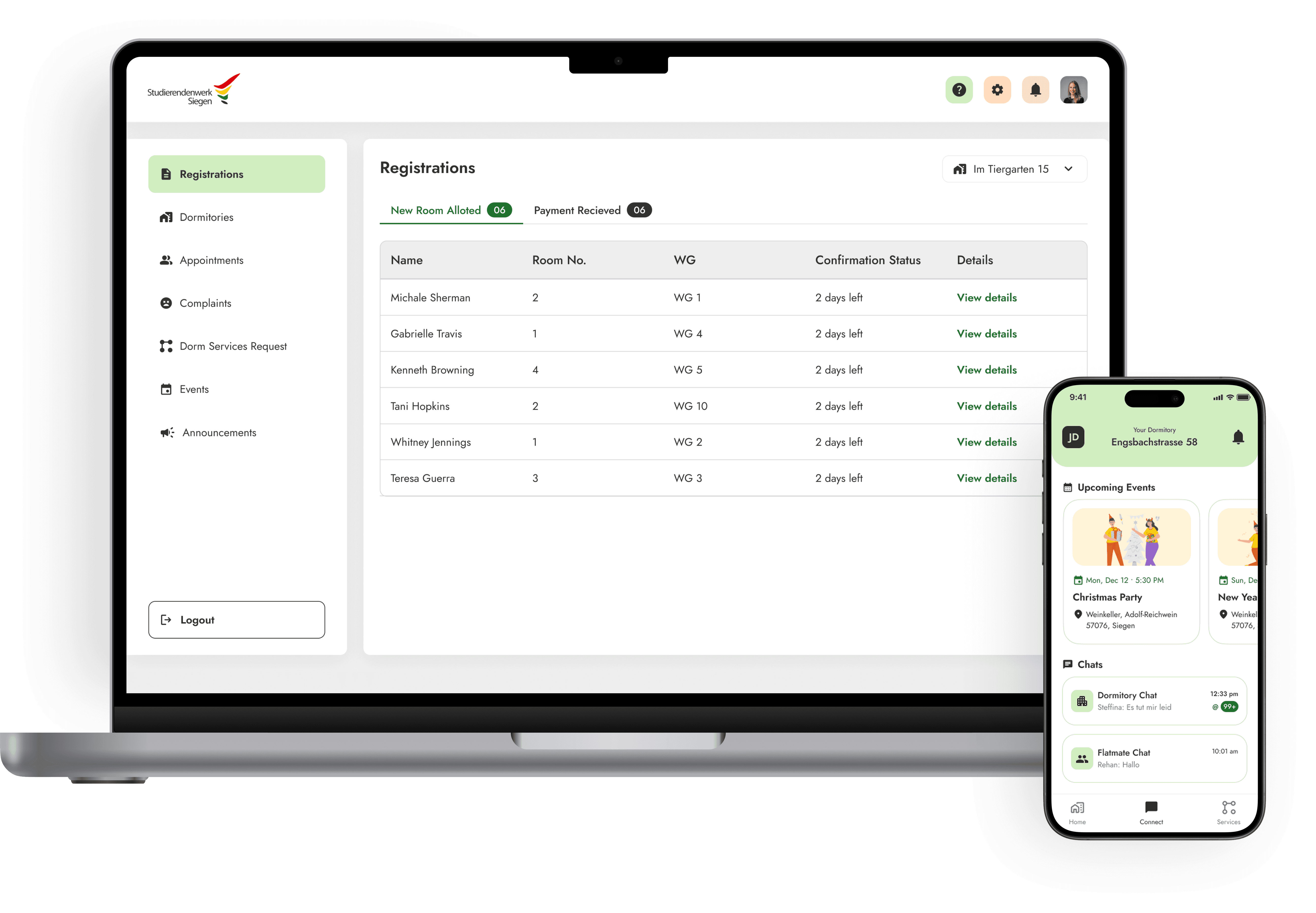
I led the end-to-end design of a mobile app and admin system to digitize dormitory services for Studierendenwerk Siegen. Through comprehensive user research with 52 students across multiple dormitories, I identified critical gaps in the traditional system and designed a solution that streamlined room booking, reduced communication delays, and connected residents with each other and administration staff.
Design Challenge
Create an intuitive mobile experience that could replace slow communication processes while serving two distinct user groups with different needs: prospective students navigating room applications and current residents managing daily dormitory life.
Context
Studierendenwerk Siegen, a student housing organization managing multiple dormitories in Siegen, Germany, relied entirely on emails for all dormitory operations which often resulted in delayed responses or no responses considering high work load. Students faced significant friction during room booking, received delayed responses to maintenance requests, and had no structured way to connect with fellow residents.
As a fellow resident of Studierendenwerk, I recognized that this approach created operational inefficiencies for staff and poor experiences for students, but lacked visibility into specific pain points or priorities. "should" have.
Key Responsibilities:
Conducted in-depth interviews with 10 students across different dormitories
Designed and distributed surveys to additional students for broader validation
Synthesized qualitative and quantitative data using affinity mapping
Designed complete user flows for both student and admin experiences
Developed high-fidelity prototypes for mobile app and admin panel
Problem
Students experienced unnecessary delays and frustration throughout their entire dormitory journey—from initial room application through daily living—because every interaction required phone calls, physical visits, or waiting for office hours.
Why it mattered:
Room application process was opaque, leaving students uncertain about status and next steps
Maintenance requests by students required sending emails (which would result in delays in responses) or in person visits or phone calls.
No structured way for students to meet neighbors or participate in dormitory community which often lead to social isolation for some students
Administration staff spent significant time handling repetitive inquiries and manual processes
Goals
Enable self-service room application and status tracking to reduce administrative inquiries
Provide instant communication channel between students and administration
Create community features to help residents connect with each other
Streamline administrative workflows through centralized dashboard
Design scalable system that could expand to additional dormitories
Research
Methods: In-depth Interviews: Conducted 10 detailed interviews with students representing different dormitories, nationalities, and length of residence to understand diverse experiences
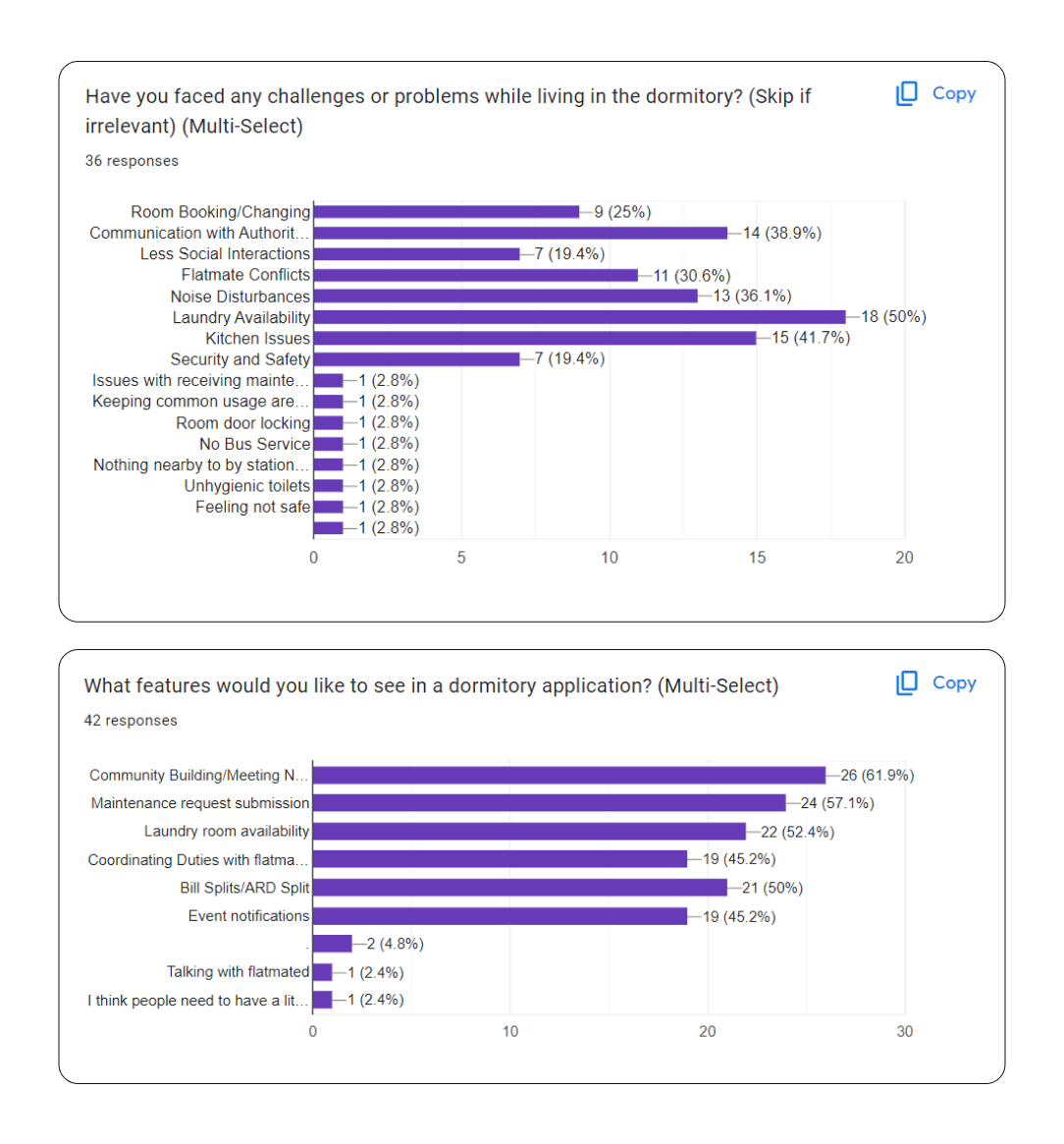
Surveys: Distributed questionnaires to students to quantify pain point frequency and validate interview findings
Contextual Inquiry: Observed current booking and communication processes to identify specific friction points
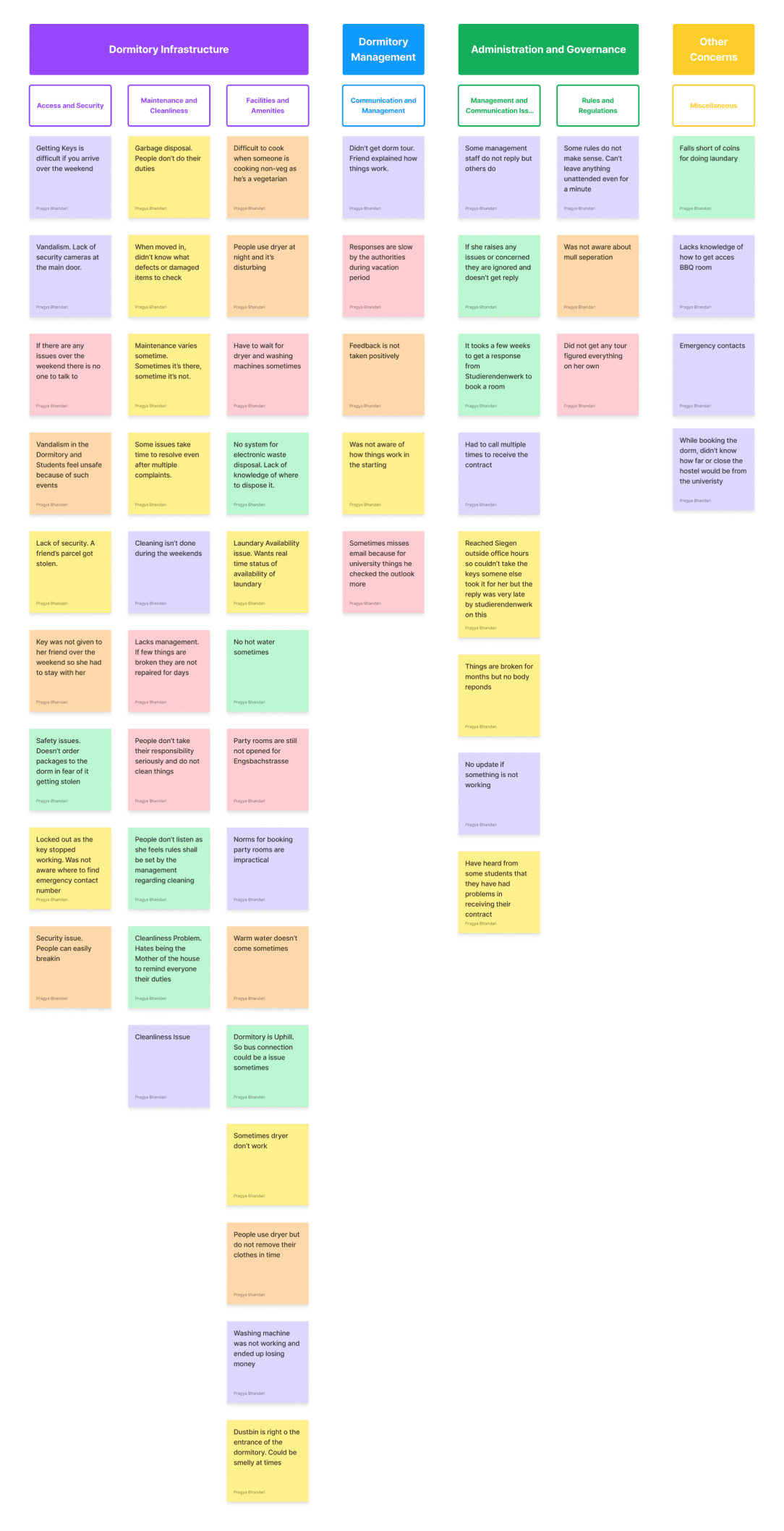
Affinity Mapping: Synthesized all research data to identify patterns and prioritize problems by severity and frequency
Key Findings
Research revealed that students' frustration stemmed not from the lack of digital services alone, but from being forced into synchronous communication for tasks that should be asynchronous. This insight fundamentally shaped the solution.
Application process lacked transparency
Students described the room booking process as a "black box." After submitting initial paperwork, they had no way to check their position in queue, view available rooms, or know when to expect next steps without calling the office repeatedly."I applied for a room two months ago but have no idea if I'm being considered or if I should look elsewhere. Calling every week feels intrusive, but I need to plan my move."
Synchronous communication blocked simple requests
Maintenance issues, general questions, and document requests all required emails or office visits during limited hours (9 AM - 3 PM, weekdays only). Students with classes or work during these hours faced significant barriers. International students often struggled with phone conversations in German.Residents felt disconnected from community
Students wanted to connect with neighbors for practical reasons (finding study partners, learning German) and social reasons (making friends, reducing isolation), but had no structured channel beyond chance encounters in hallways.
Strategy
Based on research insights:
Make asynchronous the default
Enable students to complete tasks, ask questions, and check status independently without waiting for office hours or staff availability. Reserve synchronous communication (calls, visits) for situations that genuinely require real-time interaction.
Design for two distinct journeys
Create separate but connected experiences for prospective students (focused on room search and application) and current residents (focused on daily living and community). Don't force both groups through the same flows.
Reduce administrative burden, don't shift it
Any features added to the student app must reduce staff workload, not create new administrative tasks. If a feature requires manual staff intervention, it must replace something more time-intensive.
Solution
Self-service room application and tracking
For prospective students: Enabled complete room search, application submission, and status tracking without requiring any phone calls or office visits.
Browse available rooms with photos, amenities, and location details
Filter by preferences (room type, dormitory location, price range)
Submit application directly through app with document upload
Track application status with clear timeline and next steps
Receive notifications when status changes or action is needed
Asynchronous messaging system
For current residents: Provided direct communication channel with administration for maintenance, questions, and requests without waiting for office hours.
Submit maintenance requests with photos and description
Ask questions and receive responses asynchronously
Track request status and history
Receive important announcements and updates
Community connection features
Designed social features specifically around practical student needs rather than generic social networking:
Resident directory to find neighbors by dormitory and floor
Events calendar for dormitory activities and meetups
Unified admin dashboard
Created centralized panel for dormitory staff to manage all operations:
View and process room applications
Respond to student messages and maintenance requests
Manage room inventory and availability
Post announcements and updates
Generate reports on occupancy, requests, and issues
Constraints
Limited stakeholder availability for validation
Studierendenwerk staff could only participate in research during specific windows due to operational demands during semester start.Trade-off: I prioritized validation with actual students over administrative stakeholders, focusing staff interviews on workflow requirements and constraints rather than design feedback. Student needs drove design decisions; staff input validated feasibility.
Uncertainty about technical infrastructure
As a master thesis project, I had no visibility into Studierendenwerk's existing systems, databases, or technical capabilities.Trade-off: Designed solution to be implementation-agnostic, avoiding assumptions about backend integration. Focused on user experience and interaction patterns that could work regardless of technical approach chosen for development.
Outcome
As a master thesis project, this case study represents design exploration and research validation rather than a launched product. Studierendenwerk Siegen received complete design documentation and research findings but has not yet implemented the solution.
What was delivered:
Comprehensive research report documenting pain points from 52 students across multiple dormitories
High-fidelity prototypes demonstrating complete user flows for student app and admin panel
Feature prioritization framework based on frequency and impact data
Design specifications ready for development handoff
Reflection
Academic research timelines allowed for deeper user understanding than typical product cycles, resulting in richer persona development and more nuanced problem framing.
Working independently as a thesis project meant all design decisions were self-validated. In a team environment, I would have benefited from challenging assumptions through collaborative critique.